Rabu, 29 Juni 2011

The Golandsky Institute's Summer Symposium and Piano Institute Runs July 9th to 17th in Princeton

If you're interested in learning about the Taubman Approach to piano technique, here's the place to do it this summer: the Golandsky Institute will be offering their 8th Annual Summer Symposium and International Piano Festival at Princeton University from July 9th to 17th. About the Taubman Approach:
Decades ago, Dorothy Taubman's genius led her to analyze what underlies virtuoso piano playing. The result of that investigation has produced a body of knowledge that can lead to an effortless and brilliant technique. It can also prevent and cure fatigue, pain and other playing-related injuries.

The Taubman Approach is a groundbreaking analysis of the mostly invisible motions that function underneath a virtuoso technique. The resulting knowledge makes it possible to help pianists overcome technical limitations as well as cure playing-related injuries. It is also the way that tone production and other components of expressive playing can be understood and taught.
Both programs have assembled a huge list of piano luminaries. The Summer Symposium will be featuring workshops by Edna Golandsky, John Bloomfield, Robert Durso, Mary Moran, Scott Burnham, Steve Mackey, Orli Shaham, Lisa Yui, Logan Skelton, Sophie Till, Mark Love, and Elena Sorokina. The Piano Festival will feature performances by Pavel Nersessian, Ilya Itin, Father Sean Duggan, Logan Skelton, Bill Charlap, and Yehudi Wyner.

Sounds like a great lineup and definitely not to be missed if you're in the central New Jersey area. You can even register online.

(Thanks, Karen!)

Senin, 27 Juni 2011

JS Bach Battle Royal w/Argerich, Kissin, Levine, and Pletnev

Bach's Concerto for 4 Harpsichords BWV 1065 was based on Vivaldi's Concerto for 4 Violins in B minor RV 580 from L'Estro Armonico. So rather than say Bach plagiarized it from Vivaldi (or worse yet, the politically neutral "after" Vivaldi), let's use the dense yet ubercool contemporary DJ nomenclature, ideal for parsing the different strands of a work's evolution:

Vivaldi 4V Concerto (JS Bach H-chord remix) feat. Argerich/Kissin/Levin/Pletnev w/Verbier FestOrch


(Via Eileen Huang)

Photo of the Day

Spotted by Elizabeth Grimes in New York City - how on earth does this pianist get his lovely Yamaha grand to and from Washington Square Park every day in order to play on the street?

BTW Elizabeth's blog (+Facebook page) is really, really worth a look. She's a freelance pianist whose blog looks at one magical and unique moment every day.

Sabtu, 25 Juni 2011

App Review: Metronome Plus

I use metronomes for three purposes. When I'm practicing and need a beat, it needs to be readily available, ready to be switched on, easily adjustable, and loud. In rehearsal, a conductor might ask me for a metronome marking while I'm at the piano - I need to get the metronme out and find the marking he/she wants within seconds. When teaching, I need to be able to have a metronome that is both loud and with a visual element. If students can both hear and see the beat, there's a much better chance that the pulse will sink in and they'll play in time.

While still a fan of digital stand-alone metronomes, I feel that the ubiquitousness of smartphones and iOS devices makes these devices an incredibly useful place for a useful metronome app to live, both in my own studio and those of my students.

The problem with many metronome apps (both for Android and iOS phones) is they happen to be so feature-rich that they can get difficult to navigate around the most basic functions like finding a specific tempo marking, finding a subdivision (if you need one) and turning the sound on.

This is the main reason Metronome Plus is quickly becoming the go-to metronome app in my studio. I haven't got time to dither around trying to customize the controls of some sleek ad-infested app with a complex interface. I need an app that is ready to go without any lag time whatsoever.

On opening Metronome Plus, you're presented with a small wheel at the bottom of the screen flanked by a plus and minus sign that toggle the tempo speed. The play button at the upper right turns it on. If you need further customization, you can pull down a menu from arrow at the top ofthe screen, which has settings for meter, subdivision, accent location, and sound types (I still like the default digital sound, although clave, woodblock, and shaker sounds are also available).

And that's about it. The attractive yet minimal architecture of Metronome Plus doesn't promise so much at first viewing, but over time it's the kind of metronome app that I've been coming back to over and over again.

And did I mention that the digital pendulum animation that moves from side to side looks kind of....Cylon?

Finally, I should also mention that although this app was designed for the iPhone/iPod Touch series of devices, it scales extremely well on the iPad (where I use it daily), with barely any pixellation on the larger screen.

Kamis, 23 Juni 2011

From the Violet Archer Saxophone Sonata

Music-making from Victoria: alto saxophonist Erik Abbink and pianist Nola Strand play the third movement of Violet Archer's Sonata for Saxophone and Piano. While you're listening, take a look at Erik's doctoral thesis from the University of British Columbia: Saxophone education and performance in British Columbia: Early history and current practices.


The Faber Piano Adventures Summer Workshop Tour 2011

The beginner piano method that I use in my teaching more than any other is the Faber Piano Adventures Series, and the new Second Edition brings some new twists into the method, although subtle. If you're new to this series or are interested in further exploration of ilts many uses, there's a very good chance that the Faber Piano Adventures Summer Workshop Tour might be coming to a community near you in the net few months. Here's the complete tour schedule with contact info (NB: Faber workshops are known for their freebies):

Teaching with Analysis, Creativity, and Expression (A-C-E™)
Randall Faber, clinician
July 7 - August 19
Locations - Call to register

July 7 • Van Goozen Music
Sarnia, Ontario • 519-344-2319

July 8 • Hickey's Music
Syracuse, NY • 607-272-8262

July 11 • Opus 1 Music
Evansville, IN • 812-479-6787

July 12 • Willis Music
Lexington, KY • 859-273-4063

July 13 • Amro Music
Memphis, TN • 901-323-8888

July 18 • Dietze Music
Omaha, NE • 402-333-1535

July 19 • Frank Rieman Music
Des Moines, IA • 515-261-3746

July 20 • West Music
Coralville, IA • 319-351-2000

July 21 • Kephart's Music
Dubuque, IA • 563-583-7333

July 22 • Ward-Brodt Music
Madison, WI • 608-661-8600

July 26 • Heid Music
Appleton, WI • 920-734-1969

July 27 • Brookdale Music
Naperville, IL • 630-983-5100

August 1 • Evola Music
Pontiac, MI • 248-334-0566

August 3 • Gottschalk Music
Clovis, CA • 559-298-4400

August 4 • Weather's Music
Salem, OR • 503-362-8708

August 5 • Kennelly Keys Music
Lynnwood, WA • 425-771-7020

August 12 • Popplers Music
Grand Forks, ND • 701-746-7471

August 16 • Robert M. Sides Music
Elmira, NY • 607-739-1559

August 17 • Robert M. Sides Music
Wilkes-Barre, PA • 570-824-9636

August 18 • KeyboardAmerica
Lewes, DE • 302-644-9375

August 19 • Middle C Music
Washington, D.C. • 202-244-7326

September 21 • Music & Arts
Waterford, CT • 860-442-8884

September 22 • Music & Arts
Fairfield, CT • 203-255-2881

Selasa, 21 Juni 2011

An Angry Letter to a Pianist

Yesterday I got word of a public letter to a nameless pianist who had charged for rehearsals (Update: and performance too) but neglected to learn the music. Although the person who wrote the letter gave me permission to publicize their name when posting the letter, I've decided not to. Here's the letter:
Dear Pianist(s),

If you can't play the rep, don't have time to learn the rep (and can't sight-read to make up for it), then have the courteousness to let the instrumentalist/singer know more than a week (or in this particular case, a day) before their performance. They have spent hundreds/thousands of dollars and countless hours preparing for it; have, and show, an iota of decency and self-respect.

You are so sadly fortunate that the classical music community will always need pianists, and there is no established system of peer review, or similar, in the accompanying world that will hold you accountable for your incredible behaviour.

It is a low down rotten dirty shame that you can get away with this.
Pianists: it's important to learn your notes before rehearsal and coaching sessions!  The actions of even one pianist who charges a full rate without being able to play the rep can reflect badly on all of us.

Senin, 20 Juni 2011

Joyce DiDonato on Arts Cuts in Kansas

More performing artists should speak up about state arts cuts in the US the way that mezzo soprano Joyce DiDonato has done in the Kansas City Star:

This is the Sunflower State that I have proudly boasted about across the world, fearlessly defending it even in the face of harsh quizzical looks from the most skeptical of folks (“You live where?”). It’s the state of my first piano recital and choir concert. The home field of my artistic curiosity and education. The homeland that taught me to freely dream big and without limitation; one where the arts were once alive, vibrant and supported.

I’ve welcomed the assumption of being an unsolicited but mightily proud artistic ambassador for Kansas to the great cities of the world. Now, for the first time, I feel shame. Eliminating a state arts commission is an ignorant, short-sighted, fearful and unspeakably damaging act to the spirit and soul of this great state.


Selasa, 14 Juni 2011

Michael Jackson's Smooth Criminal for Two Cellos

Luka Sulic and Stjepan Hauser are 2CELLOS. Here they are playing Michael Jackson's Smooth Criminal (the original is here for those either too young or too old to know their 80's pop).

Sabtu, 11 Juni 2011

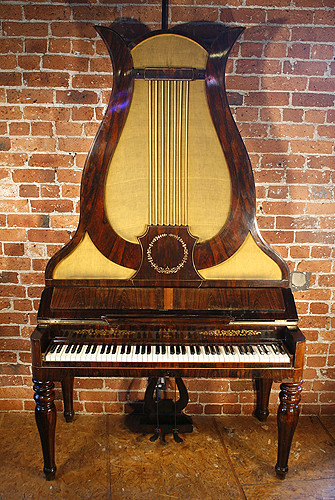
Early 19th Century Lyre Piano

This 19th century Klein lyre piano was an early version of an upright piano. The case is rosewood, with brass inlay. The Schubert Society also features a lyre piano in their collection. Just imagine playing Schubert on one of these beauties...

Selasa, 07 Juni 2011

3 Ways to More Effectively Recall Your Technique on Exam Day

When I examine students for Royal Conservatory Exams in Canada and Carnegie Hall Royal Conservatory's Achievement Program in the US, technical requirements are part of nearly every exam. And when there are a lot of students to hear in a regular examining day, I ask for the next technical requirement pretty quickly after they've finished the previous scale or chord. Therefore, you need to be going through the right thought process when getting ready to play your technique, lest your months-long preparation go for naught on examination day.

Below you'll find a quick rundown of the three main steps you need to think through when recalling each scale, chord, or arpeggio before you play them.

But first...

If you haven't done your practicing or haven't learned your technique properly, this list won't help you. Being able to recall your technique properly only works if you've actually done the work and spent the time going over each pattern and key day after day, week after week, month after month. Quite simply put, if you haven't taken the time to learn everything propery, this list will do you absolutely no good.

So if you've done the work and know all your technique, here are three steps to help you better recall it on exam day:

1. Listen to what the examiner asks for. If they ask for A flat major, don't play A major. If they ask for C minor, don't play C major. Listen carefully.

2. Think before you play. Some specifics include: What is the starting note? Which finger goes on each starting note? Where are the thumb crossings? Are there any raised or lowed accidentals to remember? What articulation should I use? What kind of tone should I play with?

3. Play. This is the easy part if you've gone through the first two steps.

Teachers: if you have any more suggestions on how students can better recall technique on exam day, leave them in the comments.

Senin, 06 Juni 2011

Miss Smith on How to Treat Your Pianist

From Fifi and Fanny, a blunt, hilarious, and informative primer on how to treat your pianist. This video should be shown to all incoming college freshmen singers and instrumentalists...


(Thanks, Craig!)

Minggu, 05 Juni 2011

Photo of the Day

Spotted in Spring Valley, NY. I couldn't have said it better.

Jumat, 03 Juni 2011

Notes from the Road

June is usually a busy time for me, and this year is no exception. Here are some of the things I'm up to these days:

  • Last Sunday I held my annual studio recital at the Royal Consvatory. You can read about some of the things I and my students learned in my most recent article for Music Teachers' Helper.
  • Right now I'm on the road examining for Carnegie Hall Royal Conservatory in New Jersey. I started out in Spotswood a few days ago, and now I'm in the middle of a three day stint in Matawan. Tomorrow evening I drive out to Spring Valley, New York for my final day of this route.
  • Back in Toronto next week, I teach frantically for a few days, then head off to Vancouver for a week of examining mostly RCM Grade 10 students.
  • Starting in late June, I plan on getting to work compiling an ebook for release sometime this summer. Most of the material is already written, but formatting and distribution need some serious thought before the ebook gets released.
  • My students have noticed that their lessons notes are looking different these days. I've completely ditched handwritten lesson notebooks (my handwriting is illegible anyway) and now bring a laptop to every lesson in order to type out comments, assignments, and goals on Evernote. I'm going to write about this process in the coming weeks.
  • Finally, I just bought an iPad! I'm fascinated about using a tablet device for performing and teaching, and have already downloaded some cool apps that I'll get a chance to try out in the coming weeks. If you have any great music teaching or performing iPad apps to recommend, leave a note in the comments. 

The Top 30 Classical Music Blogs for June 2011

Here is the latest instalment in Wikio's classical music blog rankings and I'm glad to see CPB move up three places to #10. Elaine Fine's Thematic Catalog is an interesting addition to the list, and debuts at #19. That means that Elaine now has two blogs in the top 30, the other being Musical Assumptions at #9. Erica Sipes' blog continues its ascent, moving up from #20 to #14 in only its second month on the list. If you notice any other interesting movements or hidden gems, tell us about it in the comments...


1Alex Ross: The Rest Is Noise
2Proper Discord
3Opera Chic
4Sandow
5Adaptistration
6Clef Notes
7Opera Today
8Michael Huebner's Blog & Column - al.com
9Musical Assumptions
10The Collaborative Piano Blog
11Sequenza21/
12Ionarts
13The Opera Tattler
14Erica Ann Sipes - pianist and cellist
15Nico Muhly
16Of Music and Men
17Andrew Patner: The View from Here
18Eric Edberg
19Elaine Fine's Thematic Catalog
20NobleViola
21Jason Heath's Double Bass Blog
22AfriClassical
23oboeinsight
24A Beast in a Jungle
25MusicaSacra
26Chamber Music Today
27The Classical Beat
28Likely Impossibilities
29The Stark Raving Cello Blog
30Violinist.com

Ranking made by Wikio
Related Posts Plugin for WordPress, Blogger...